HR & Payroll
GitHub
A Bolt workspace for employment records, rosters, leave, claims, loans, payroll and statutory contributions across nine jurisdictions (SG, MY, PH, ID, VN, TW, CN, JP, TH). A payroll run builds one payslip per employment contract and links it to the records it settled.
Apps and roles
| Application | Tasks |
|---|---|
| Employee self-service | Own schedule, leave, claims and payslips |
| Entities | Legal entities, shift patterns and definitions, holidays |
| People | Profiles, employment contracts, face enrolment and offboarding |
| Events | Roster and attendance, leave, claims, one-time payments, loans |
| Payroll | Regular and off-cycle runs, payslips and exports |
| Settings | Jurisdiction versions, catalogues, rules and behaviours |
The five HR apps live under src/app/hr_controller/; employee self-service is src/app/hr_employee/.
Teams (src/access_control/team/+team.ts) are source declarations that link these policies:
| Team | Policy | Apps |
|---|---|---|
| Employee | employee |
Employee self-service |
| Supervisor, Production Manager | supervisor |
Employee self-service, People |
| L1 Manager | manager |
All HR apps and self-service |
| Senior Management | senior_management |
All HR apps and self-service |
| HQ Payroll HR, Manager (HR Controller) | hr_controller |
All HR apps and self-service |
| HR Manager | hr_manager |
All HR apps and self-service |
| Attendance Kiosk | kiosk |
The attendance kiosk |
Automations run as hr_controller (calendar_tick, behaviour_taps with payslip_hold_automation) or their own
*_automation policy; src/access_control/policy/grants.ts holds the grant fragments policies share. Seed packs
carry each staff member's team handle in sys_user.team.
Kiosk. attendance (/kiosk/attendance) is the chromeless attendance-capture device for the Attendance Kiosk
team.
Data model
Country law is data, not code. Each jurisdiction is a lineage of dated, sealed jurisdiction_settings versions with
their catalogue rows (statutory_contribution_catalog, leave_catalog, claim_catalog, adhoc_catalog,
loan_catalog, allowance_catalog, work_catalog) and rule_set rows. Rates, bands, eligibility and pricing are CEL
expressions on those rows; behaviours are event rules on the settings version. The engine in
src/lib/payroll_engine/ evaluates them and holds no jurisdiction-specific logic. A change of law is a new version,
made without touching source. Jurisdiction versions also own their suspension kinds (a validated custom field).
What each jurisdiction configures is tracked in the jurisdiction trackers; the latest statutory audit is in docs/audit (see Compliance audit).
Automations
| Automation | Trigger | Result |
|---|---|---|
behaviour_taps |
Row events on runs, payslips, contracts, profiles, entities and entries | Applies the version's behaviour rules: each reads its declared rows and returns the writes. |
statutory_drift |
Every Saturday 03:00 UTC; also Run now | Researches every sealed in-force lineage (or the one code given) concurrently; a verified change becomes an unsealed draft. |
late_arrival_notice |
Every five minutes | One reminder per person-day when a rostered shift has no clock-in after the entity's grace. |
calendar_tick |
Daily | Runs the behaviour rules for every employment in force, so date-driven duties raise tasks. |
invitation_profile |
Staff invited; staff user created or contact changed | Creates employment profiles for invited staff and links their identities after acceptance. |
Any automation that needs no input can be started by hand from Settings → Automations → Run now.
Statutory research
One statutory_drift run maps every in-force lineage onto its own multi-step ctx.ai.sys_2.infer call with
Effect.forEach(..., { concurrency: 'unbounded' }): the nine lineages research at the same time inside one run, and a
lineage that fails is reported in the output's failed list without stopping the others. It never seals.
- Tools:
web_searchand the confined browser (browser_navigate,browser_snapshot,browser_act; a PDF opens as its extracted text, page by page), granted by thestatutory_drift_automationpolicy;steps: 1000, then one tool-less turn to submit. - Draft: the complete snapshot is the model's draft. Every list is keyed by
code, so the draft tools (read,find,edit,diff,submit) address rows as/snapshot/<section>/<code>/<field>, never by position. The research registry (settings.sources) is not in the draft: its entries reach the model as entry points and remain the browsing and citation allowlist; the successor keeps the governing version's registry. - Evidence: every changed or added row cites, in its own
references, an allowed officialurland the exactquote. The automation diffs the draft against the original (jsonDiff), refetches each cited page and drafts only when every changed row carries a fresh quote that re-appears on its page. Removed rows, settings and suspension-kind edits are never drafted; they stay inunresolved. - Coverage: the draft lists
wage_hours,leave,contributions,tax,filingsandrecordsaspending; a CEL rule refuses submission until each isverifiedorunverified. A run that ends with a pending scope is reported as<CODE>: incomplete — …infailed;changed: falsewith every scope resolved is a verified no-change. - Change summary: composed from the diff (rows added and changed per section, with field names) plus the model's
one-paragraph
summary. - Out of scope: public holidays — per-entity rows published separately, never researched.
Every tool step is recorded on the run as an infer.tool event in the workspace's runtime log.
Every workspace automation — started, scheduled, cron-driven or row-event, behaviour_taps included — runs in one
lane per workspace; only Bolt's own housekeeping runs beside it. While a sweep runs, behaviours (exit encashment,
payslip holds, settled-entry pins, obligations), calendar_tick and late_arrival_notice queue behind it and run
when it ends.
Behaviours
Every lineage carries the same ten rules (behaviours.rules on the version); what differs per jurisdiction is the
catalogue data they read.
| Rule | Event | Effect |
|---|---|---|
encash-leave-on-exit |
Contract gets an exit date and ground | One ENCASHMENT leave entry per class with encash_on_exit |
retract-exit-effects |
The exit is moved or undone | Withdraws the unsettled encashments and open exit tasks it raised |
encash-leave-at-window-end |
Daily, at a leave window's end | Encashes the unused balance of classes with encash_at_window_end (PH SIL) |
raise-tasks |
Row events, daily, after exit, calendar | Regulatory tasks from the version's TASKS rules (final wages, data disposal…) |
raise-obligations |
Payroll run created | Filing and remittance obligations from OBLIGATIONS rules |
pin-settled-entries |
Payroll run created | Links each settled entry to its payslip |
hold-payslips |
Payroll run created with holds | Moves the held people's payslips to ON_HOLD |
withdraw-run-duties |
Payroll run deleted | Withdraws that run's obligations |
write-public-holidays |
Entity created / calendar | Writes the version's public holidays to the entity calendar |
payroll-run |
PAYROLL_CREATE |
Admits REGULAR and OFF_CYCLE runs |
Exit encashment is on for annual leave in every lineage except JP (no statutory payout); TW also encashes rest-day in-lieu and comp time.
Payroll
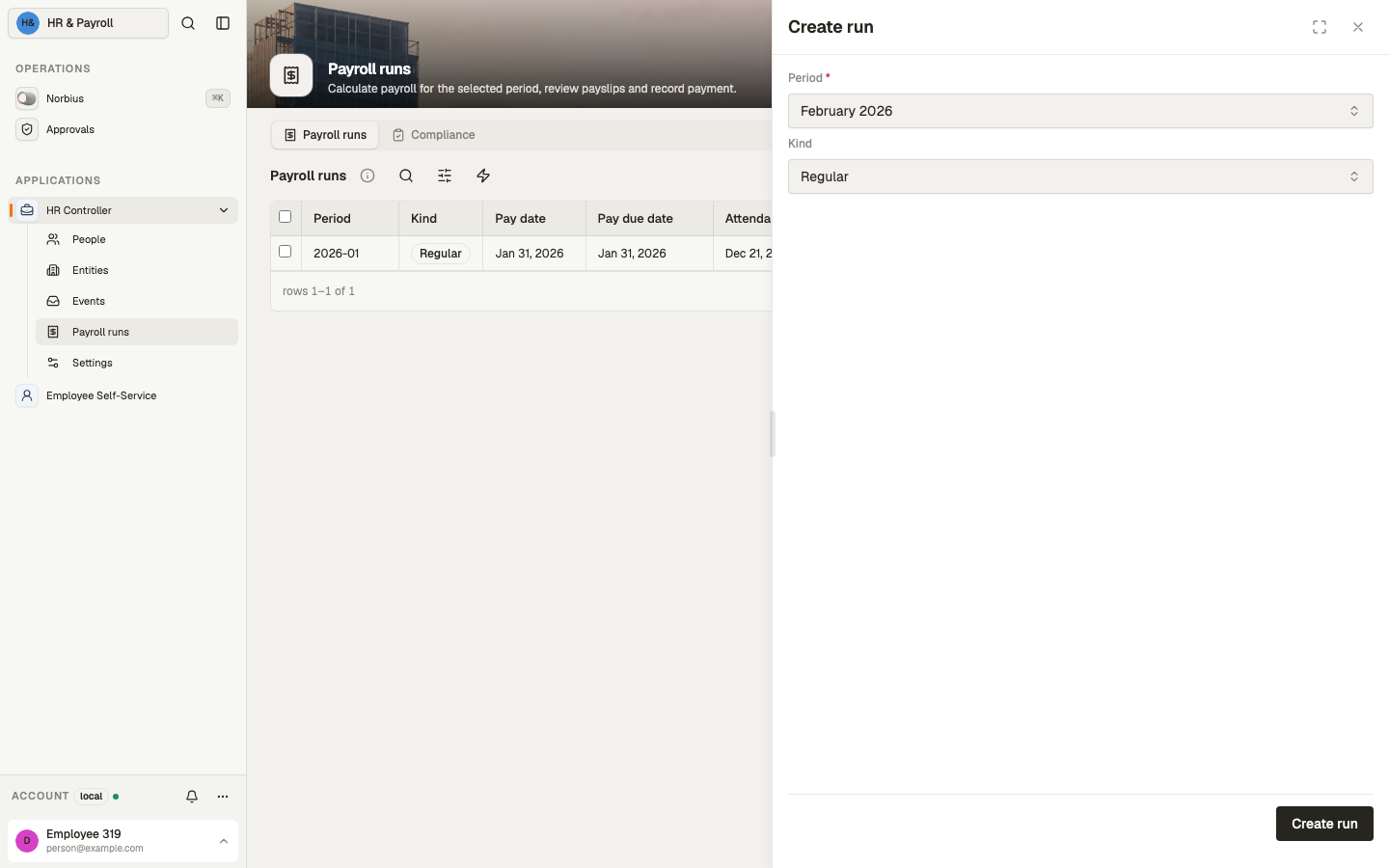
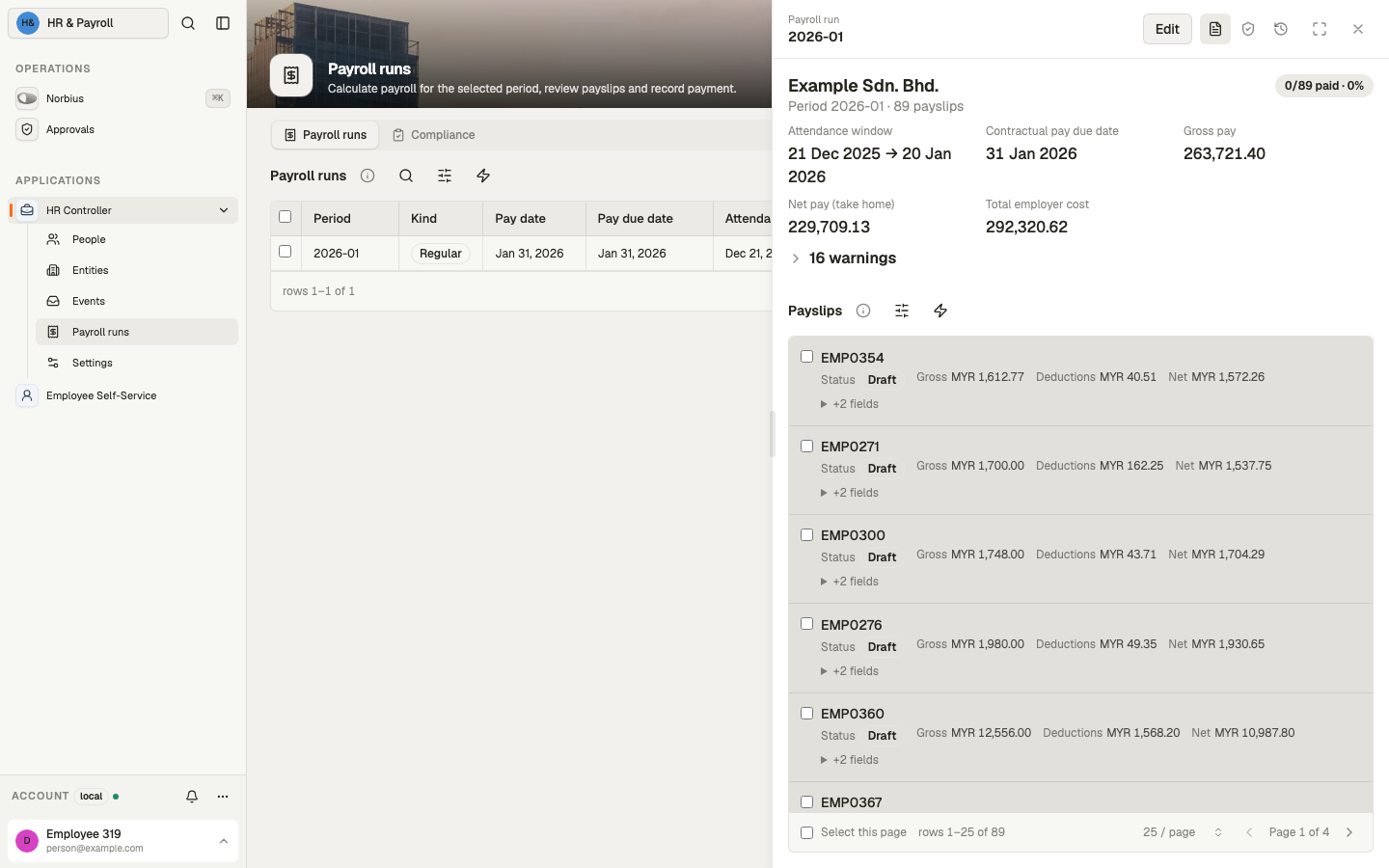
Regular run. Payroll → New → period. Pays salary and every approved, unsettled entry dated in the period; one per period.
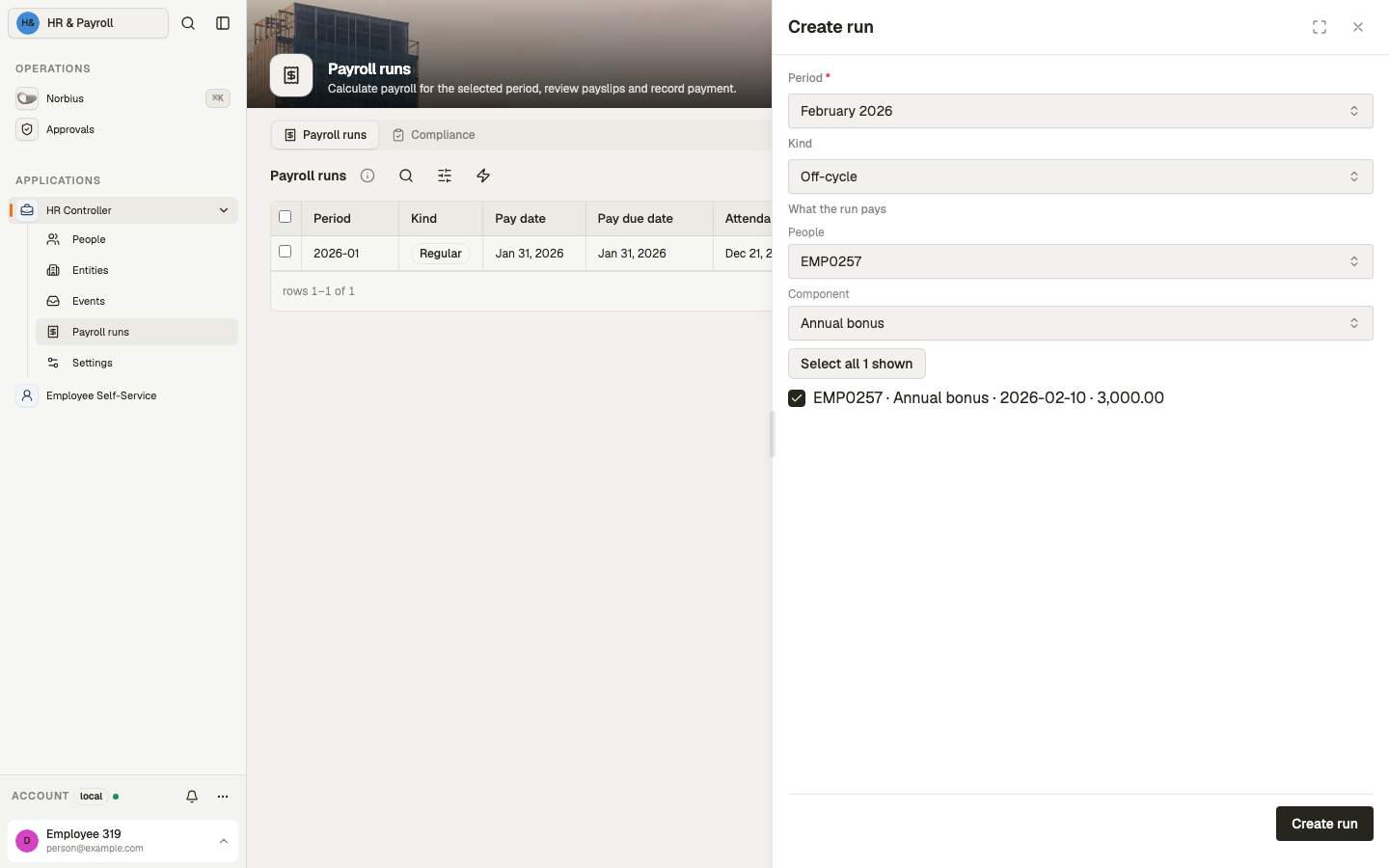
Off-cycle run. Payroll → New → Kind Off-cycle. Pick people and components (multi-select comboboxes) to narrow
the list, then tick the entries to pay. Only approved, unpaid entries of the families the version allows
(payroll.off_cycle_families, default ad hoc and claims) can be selected; the run pays those entries and no
salary. Statutory contributions settle month to date: whichever order the off-cycle and regular runs come in, the
month's totals equal one combined run.
Statutory charges are never deferred. Every run, regular or off-cycle, settles the month to date: the slip line is
the month's charge less what earlier runs of that month already charged. Whether regular pay is still to come is a
person fact in each scheme's CEL (normal_pending), not an engine branch, so an off-cycle bonus slip withholds its own
PCB, CPF, SSS… on the spot and the month's total always equals one combined run.
Jurisdiction inputs. Inputs only some jurisdictions need (dependants, spouse status, religion, fixed-term flag, a
loan's permitted purpose…) are declared per lineage in employee_input_schema and stored as contract-term facts
(terms.facts.*) or loan facts (entry.facts.*), not as columns every entity carries.
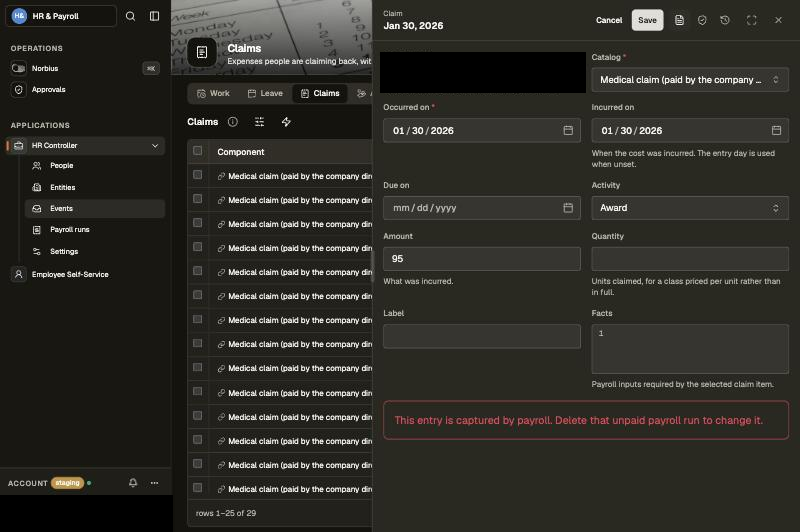
Re-run. Delete the unpaid run and create it again. Consumed entries are read-only until then.
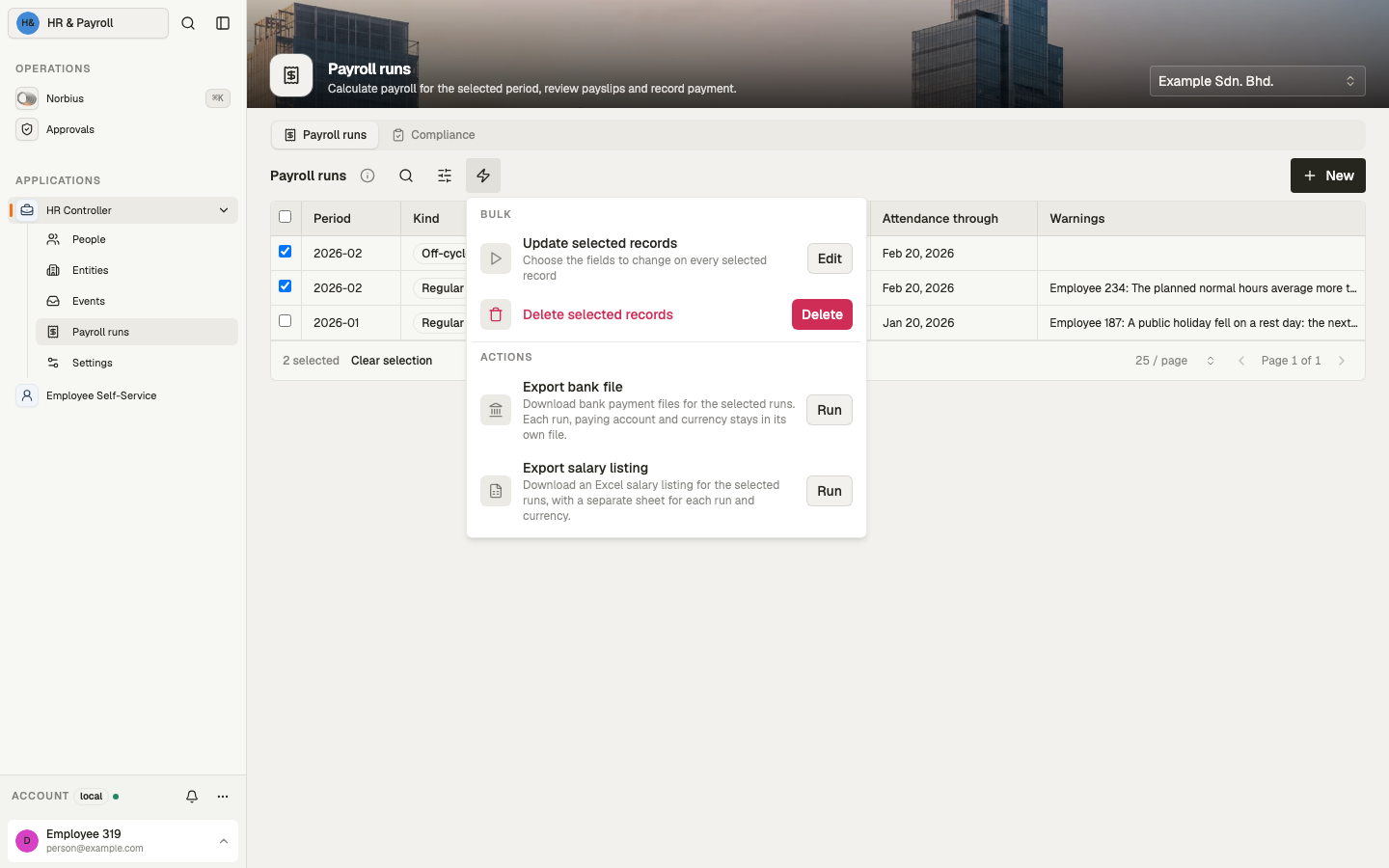
Exports. Select runs → ⚡:
- Export salary listing — one XLSX sheet per run and currency: title, run line, frozen header (
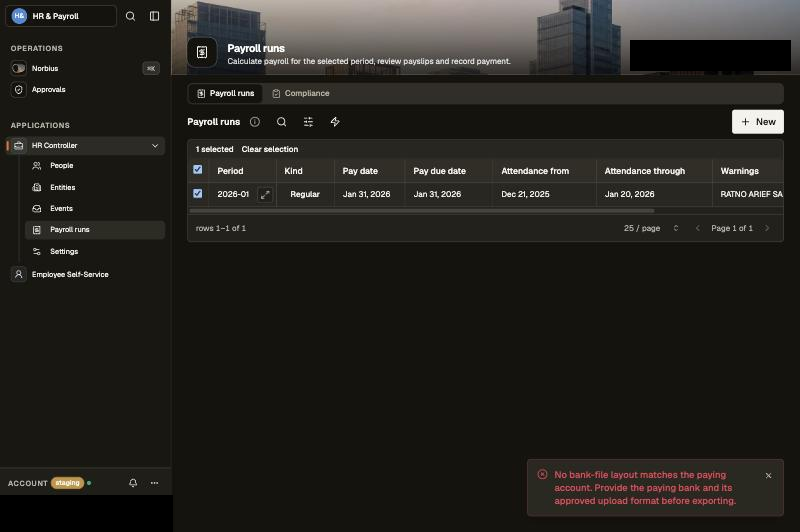
D8), columns grouped by family (basic, allowances, entries, employee statutory, deductions, net, employer statutory) and a final Total company payment that reads "Needs confirmation" until bank charges are known. - Export bank file — the paying account's bank layout; refuses until one is configured.
Import
Events → Work → ⚡:
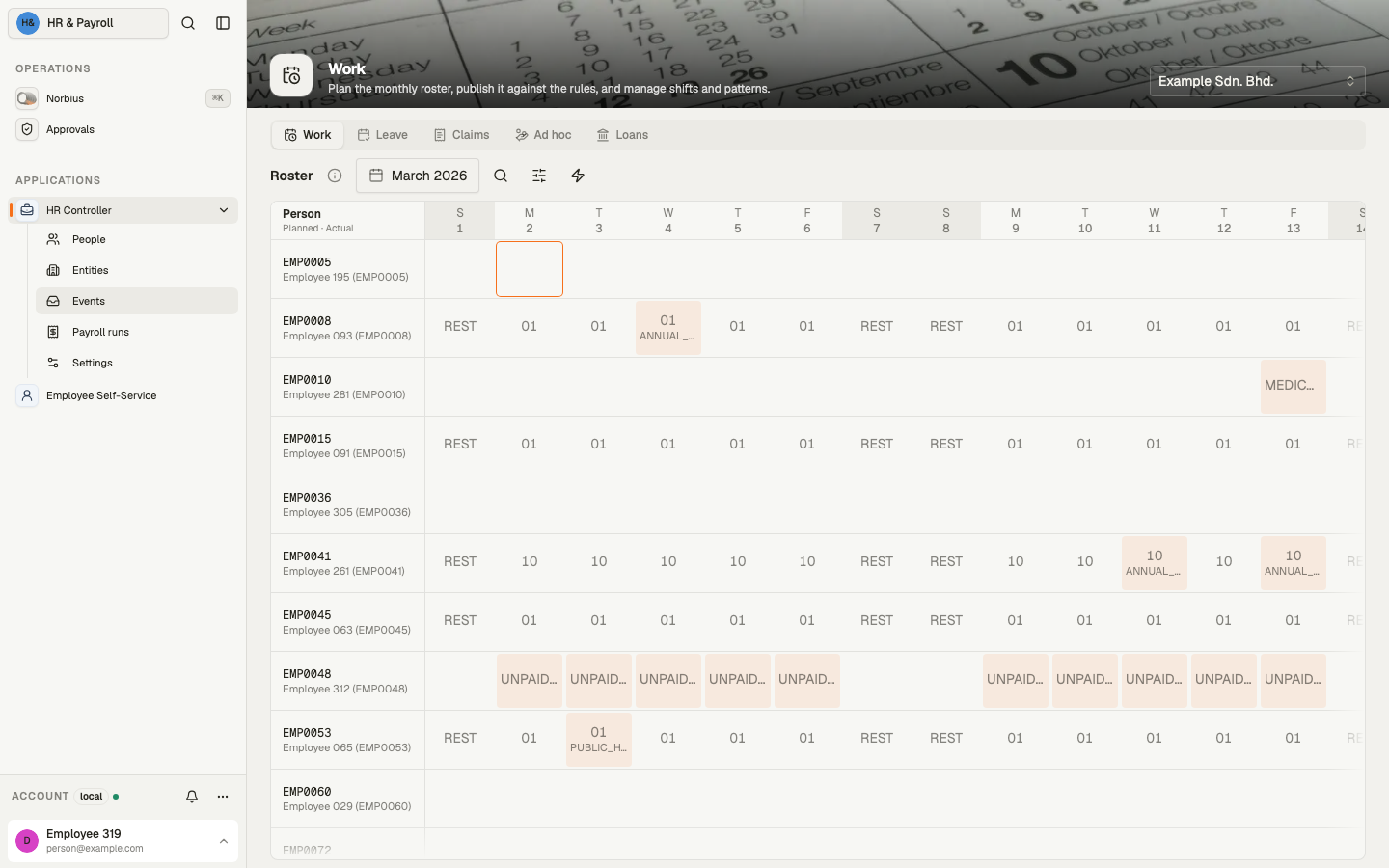
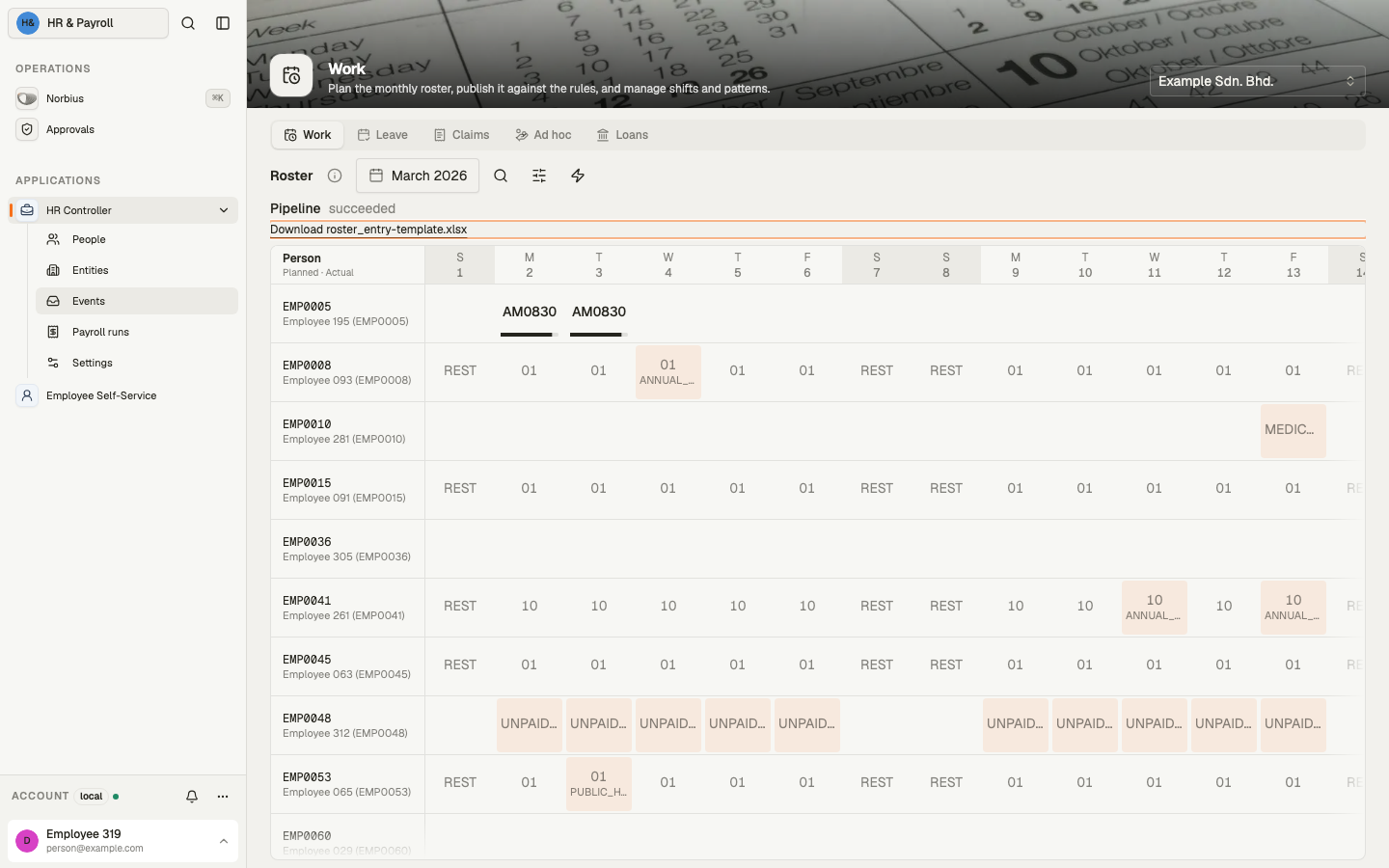
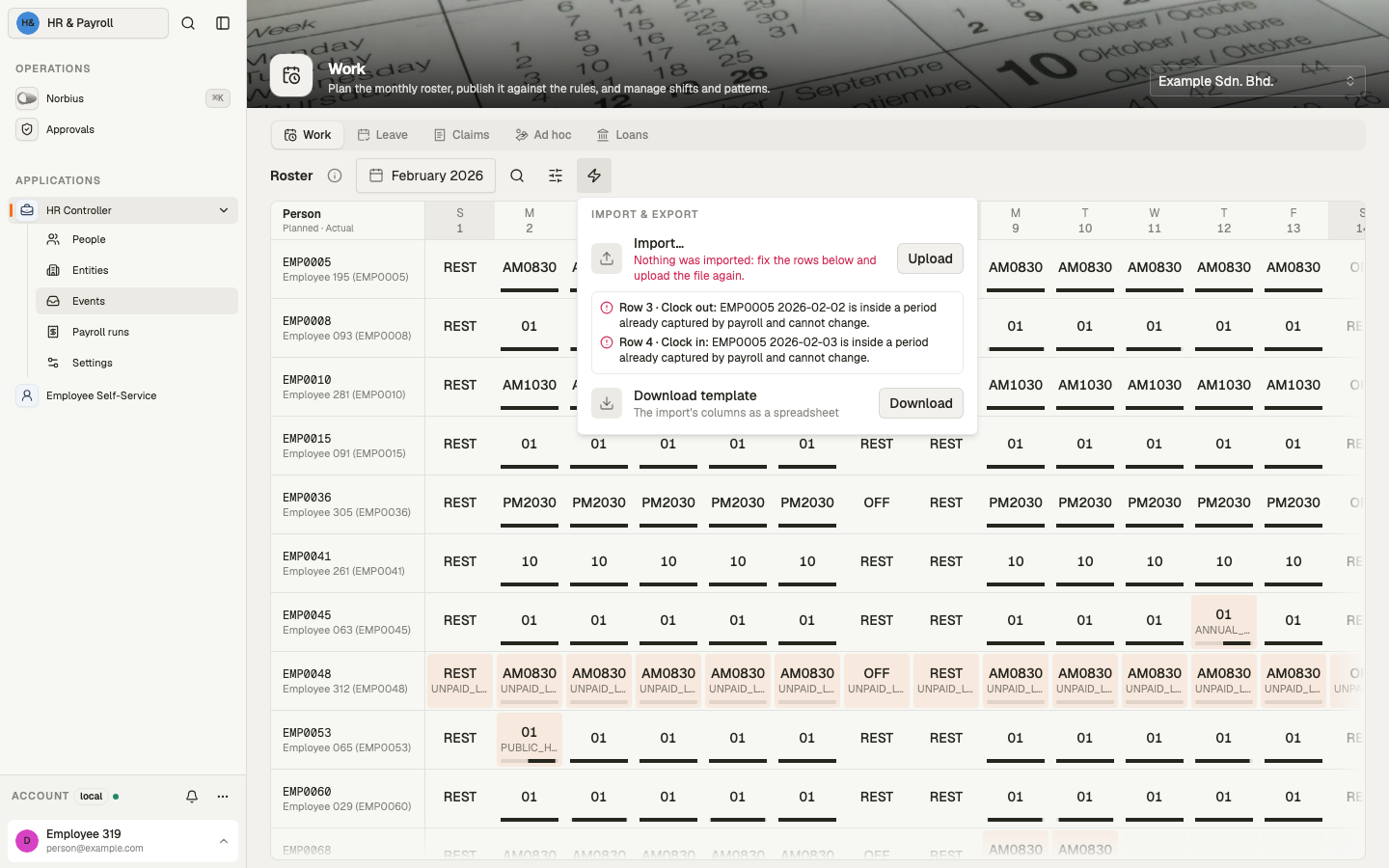
- Download template — the work-day sheet for the selected entity and pay period, prefilled with what is stored (employee number, date, shift, clock in/out, OT consent, banked OT, leave, planned and approved OT windows). The file appears as a download link when the template run finishes.
- Import… — previews first: rule warnings (for example EA s.60A breaks and spread-over) must be accepted with Accept and import. The import is a set over each person's days in the file: rows are created or updated, unsettled days the file leaves out or blanks are deleted, and a settled day may only be restated unchanged.
Verification (2026-10-22)
Run locally against the private sample pack on local Colony. Names, employee numbers and entity names in the screenshots are masked; amounts are real.
| Area | Proof | Status |
|---|---|---|
| Area | Proof | Status |
| --------------------------- | ----- | ------ |
| Gates | bolt check ok; bolt test e2e 41/41; vitest.node.config.ts 1,154/1,154 |
✅ |
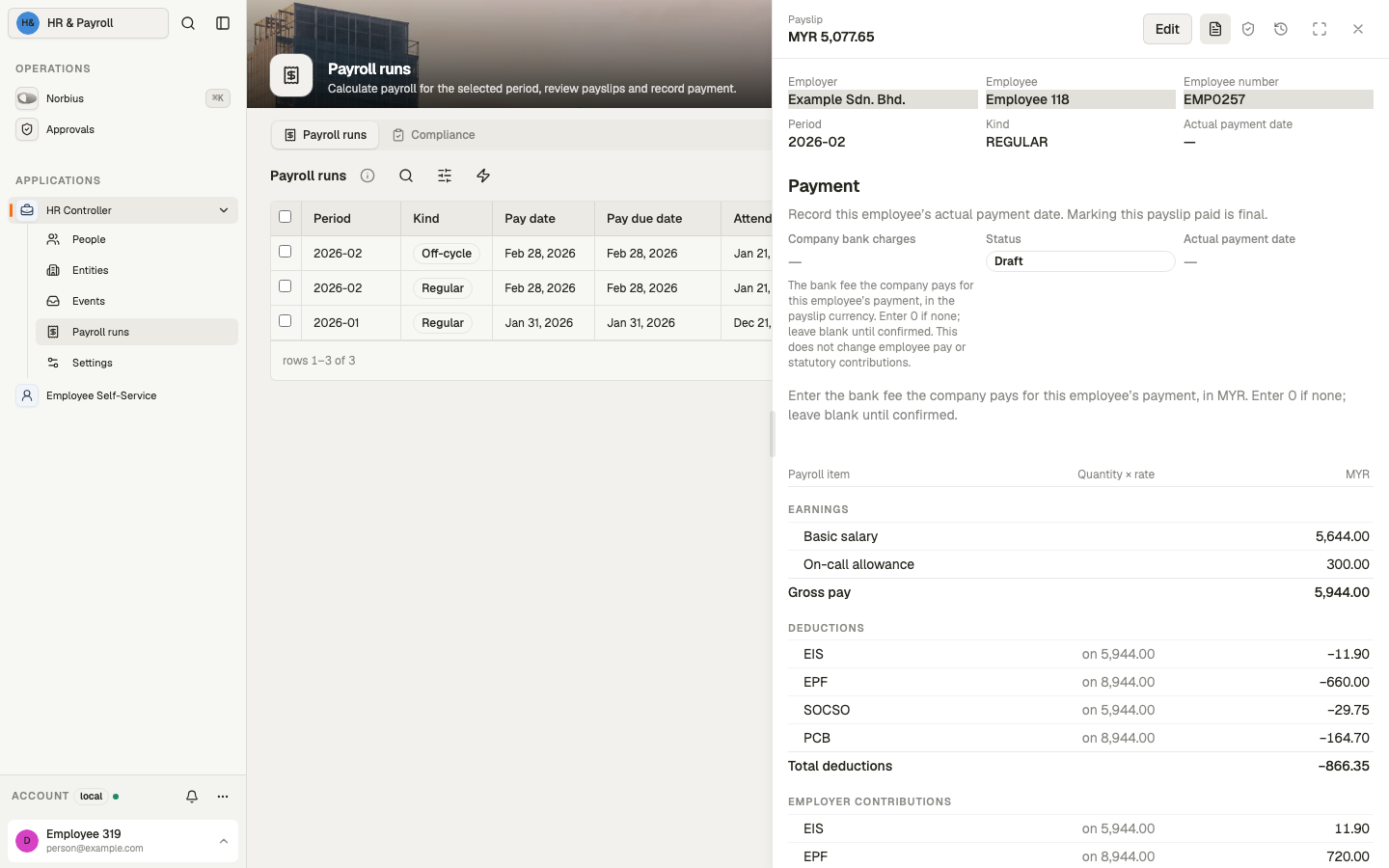
| Payroll calculation (MY) | Jan 2026 slip, RM5,944 citizen: EPF 660/720, SOCSO 29.75/104.15, EIS 11.90/11.90, HRDF 59.44, PCB 164.70 — each recomputed by hand from the schedules and the MTD formula | ✅ |
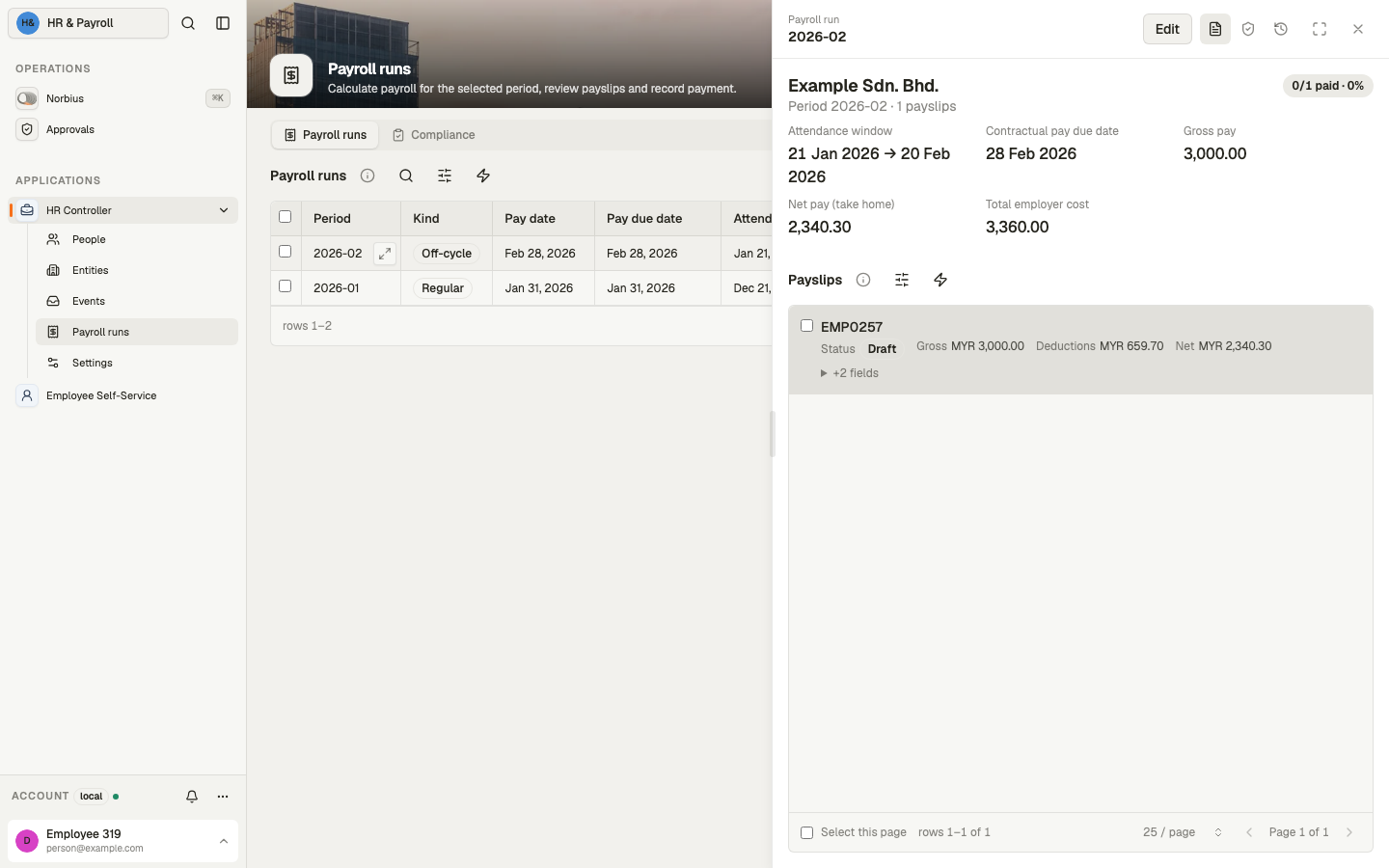
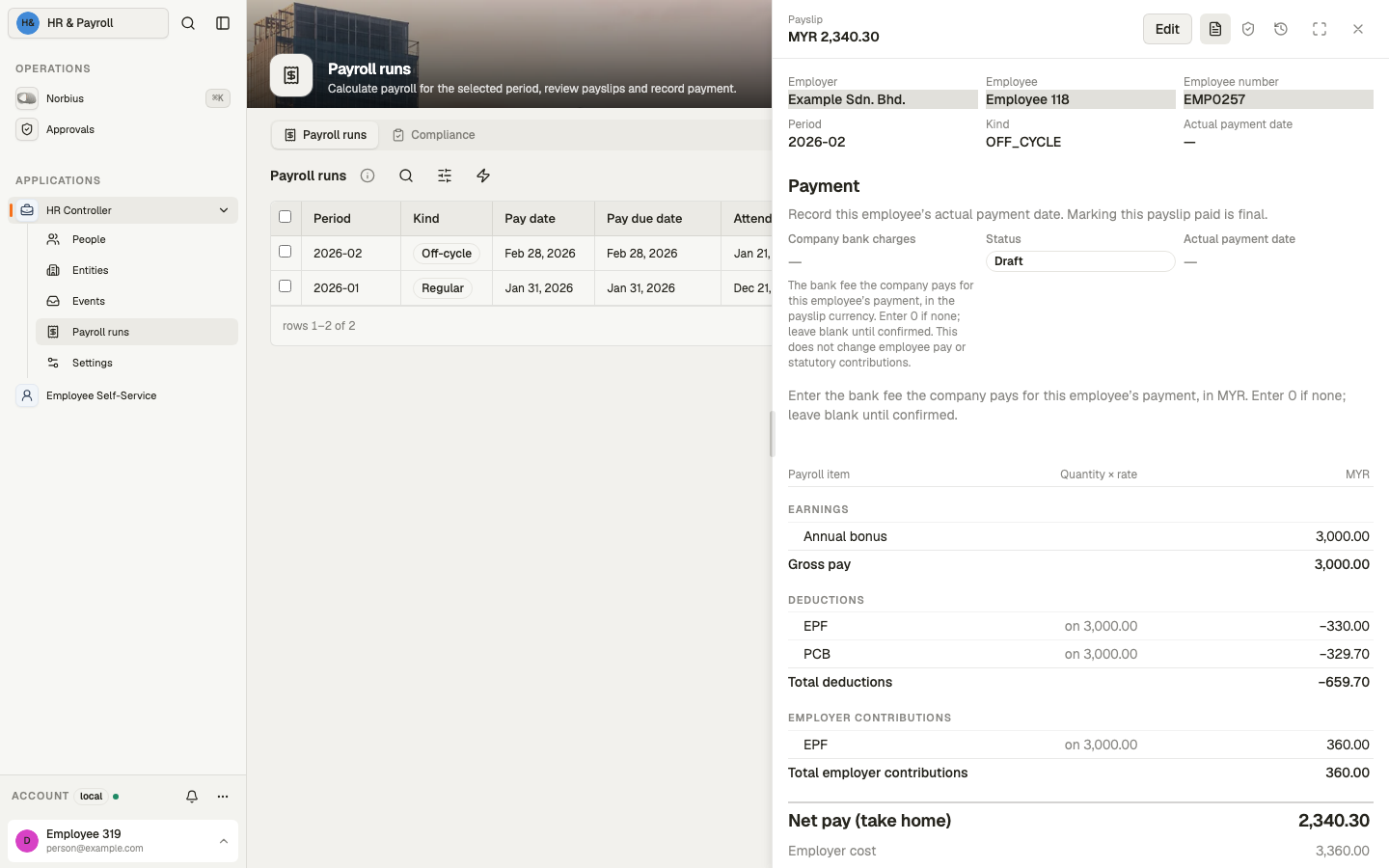
| Off-cycle, statutory on the spot | RM3,000 bonus paid off-cycle in Feb: the slip has no salary lines and withholds EPF 330/360 and PCB 329.70 itself | ✅ |
| Salary unchanged | The later Feb regular slip still pays BASIC 5,644 + allowance 300 and charges EPF on 8,944 month to date (660): Feb EPF 990/1,080 = 11%/12% of the RM9,000 band, PCB 164.70 + 329.70 = one combined run | ✅ |
| Export | Salary listing: one sheet per run and currency, values equal the payslips | ✅ |
| Import | March template downloaded, two days edited, re-imported: exactly those two days created; the same import into the paid February period is refused row by row | ✅ |
| Exit encashment | Resignation → ENCASHMENT of annual leave plus final-wages and data-disposal tasks (e2e exit-encashment) |
✅ |
| Statutory research | One run started from Run now; see Statutory research run | ⚠️ 8/9 |
Payroll run and payslip
Off-cycle run
People and Components are comboboxes (Components multi-select); only the ticked entry is paid. The off-cycle slip withholds EPF and PCB on the bonus; the regular slip that follows keeps the contractual salary and settles the month to date.
Exports
Work import
Exit encashment
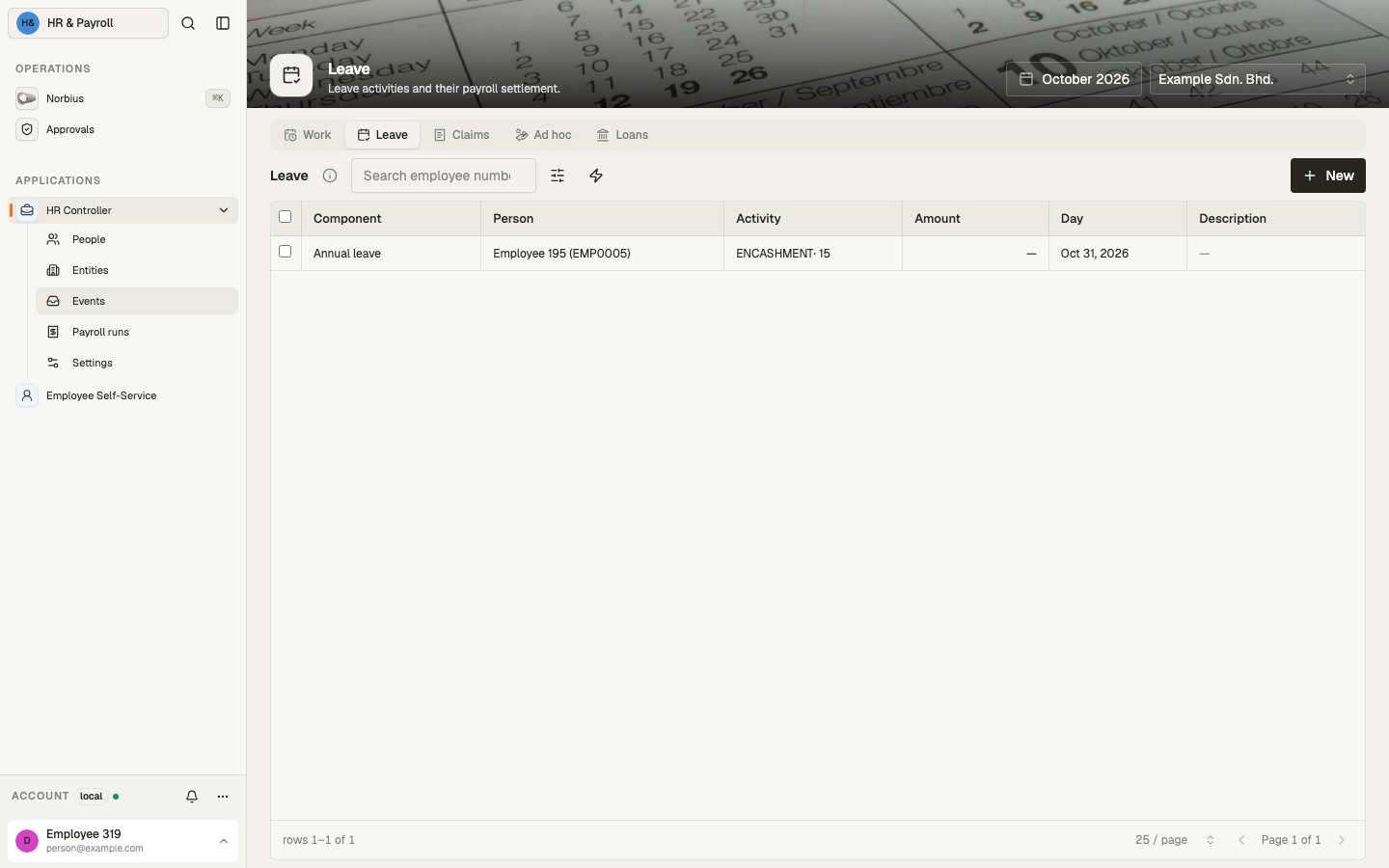
The resignation's annual-leave encashment, raised by the encash-leave-on-exit behaviour; the Activity column shows
the entry's activity and days.
Statutory research run
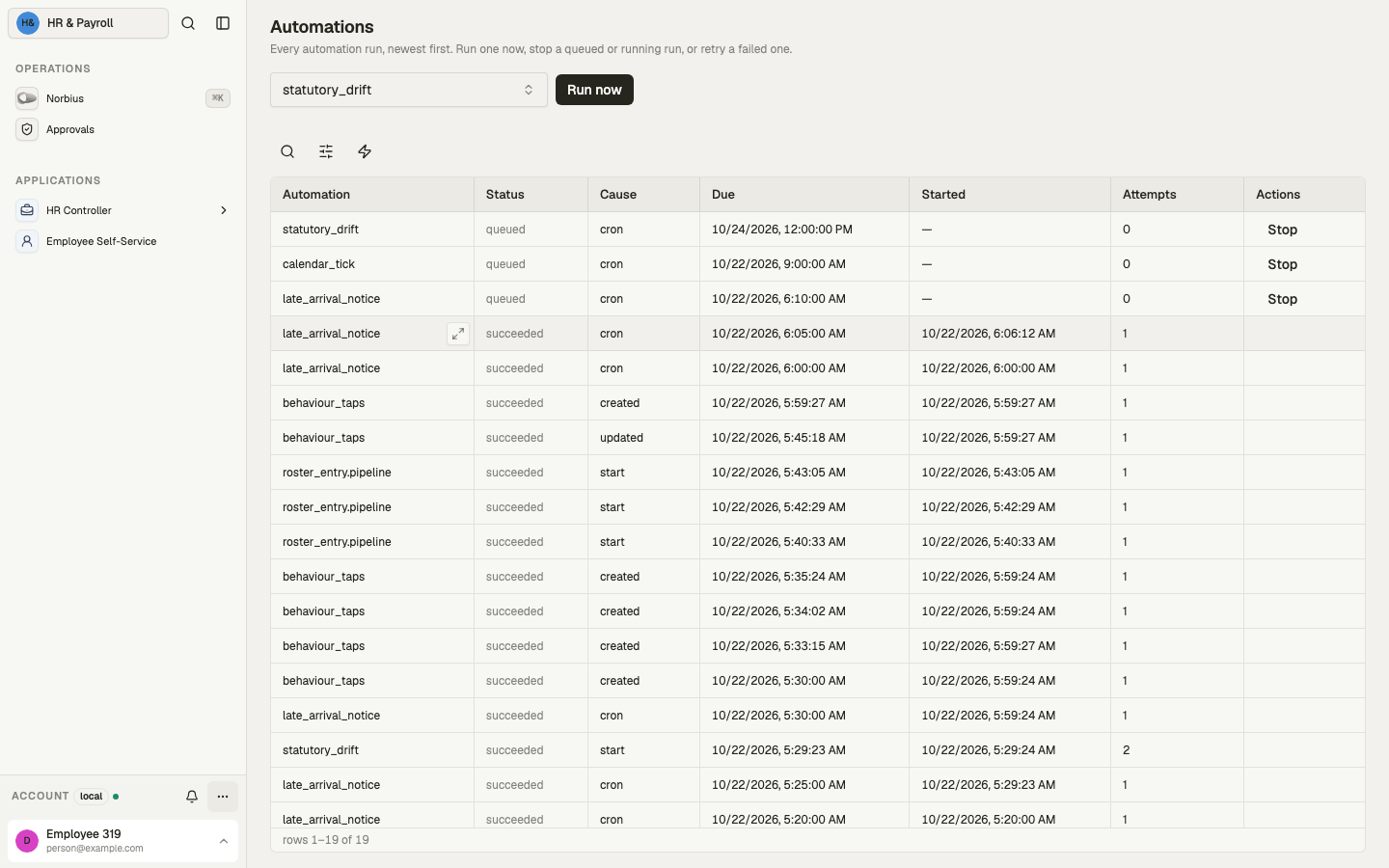
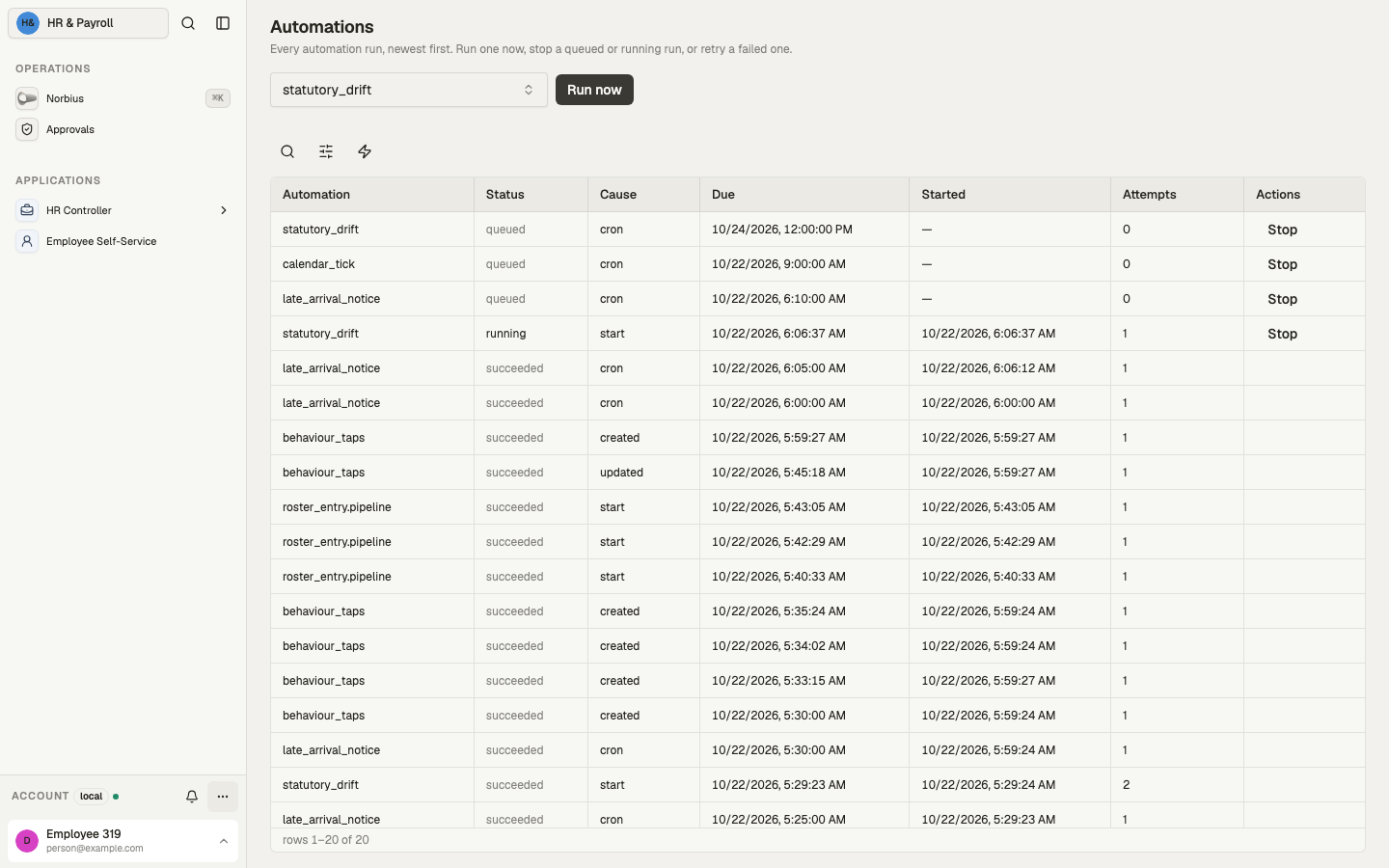
Run 01a16136 (local Colony, 2026-10-22, attempt 2: attempt 1 was interrupted at 21 min by a dev-server reload and
retried) researched all nine lineages in one run:
| Measure | Value |
|---|---|
| Duration | 01:46:27 → 02:12:42 UTC (26 min); tools stopped at 02:10:32, the 80% answer deadline |
| Tool calls | 487: web_read 334, web_search 146, browser_navigate 6, interleaved across lineages |
| Lineages | CN, SG, MY, TW, TH, PH, VN, JP, ID |
| Drafted | none |
| Failed | CN: the final answering turn's model call returned nothing within the 20 s model wall |
Eight lineages answered without a verified change, so nothing was drafted. The draft starts as changed: false, so a
lineage that ran out of tool time before patching also reads as "no change": the run cannot yet tell a verified
no-change from an unfinished review. CN's snapshot is the largest; its final turn, carrying 24 minutes of findings,
did not start streaming within Bolt's 20 s per-call wall.
Earlier staging walkthrough (2026-10-21)
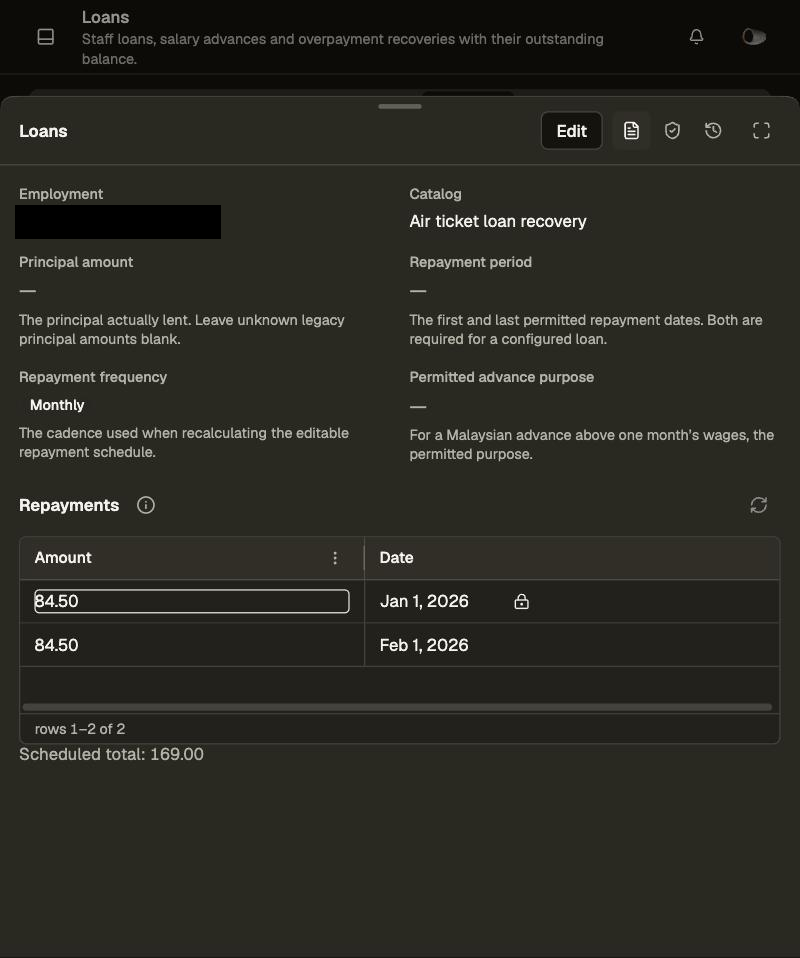
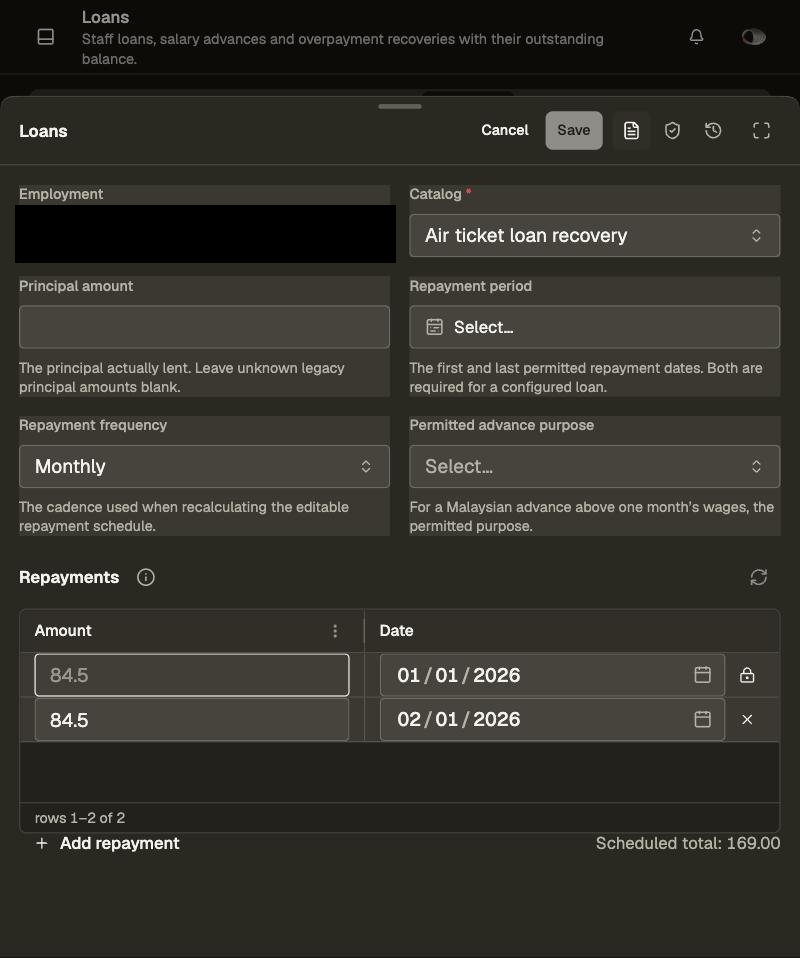
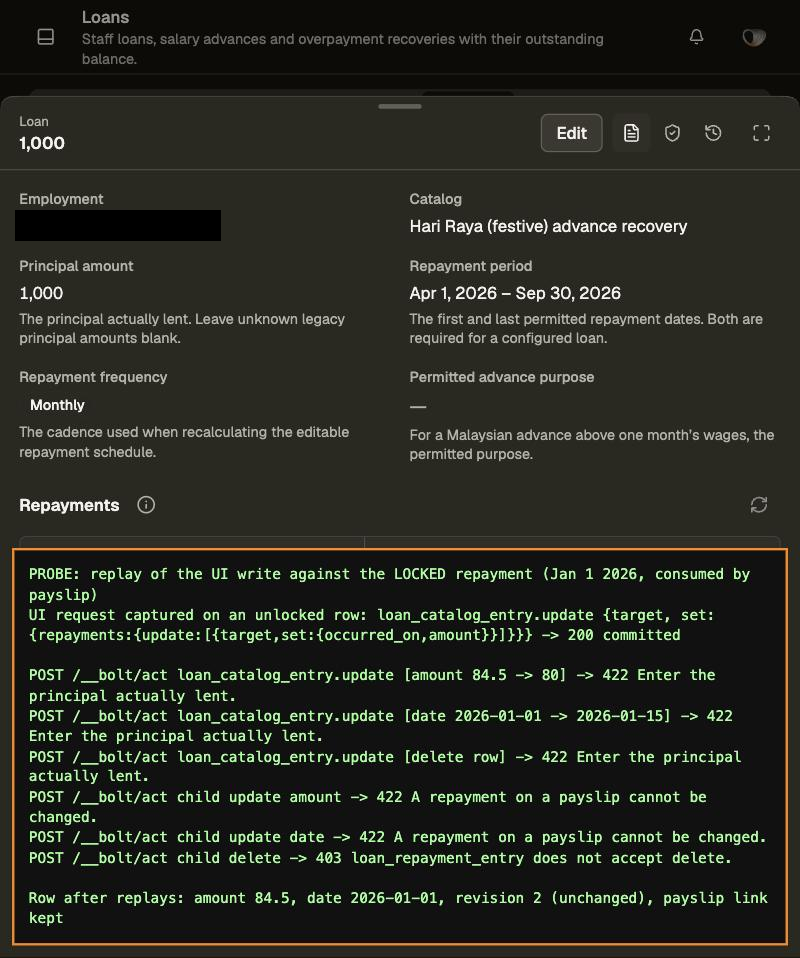
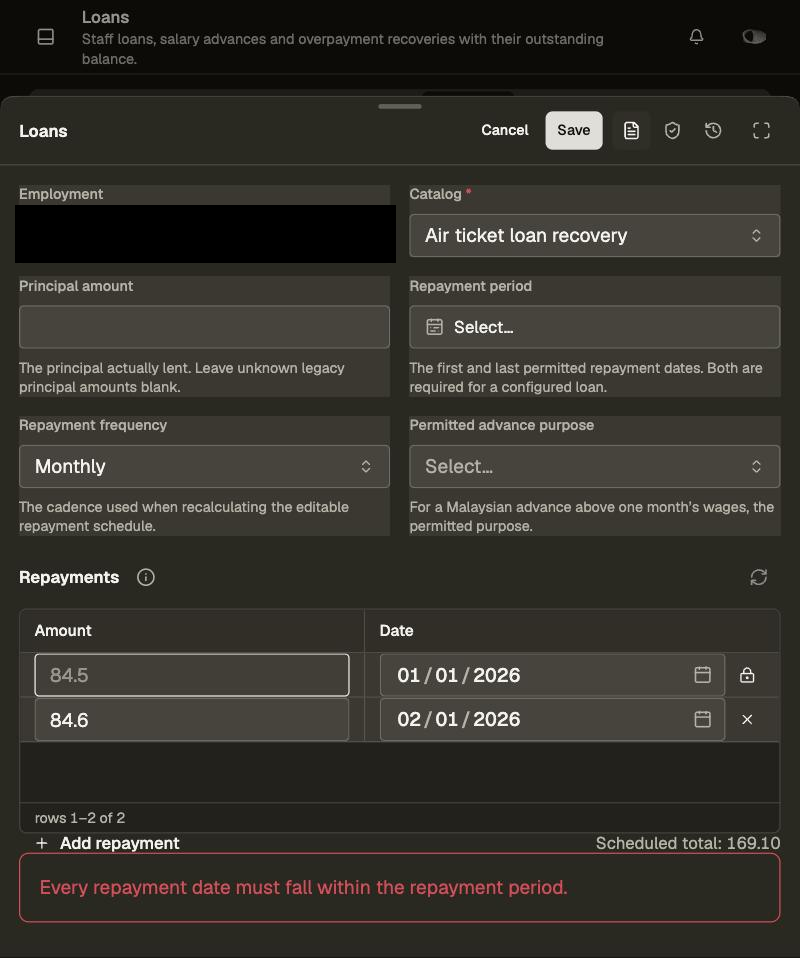
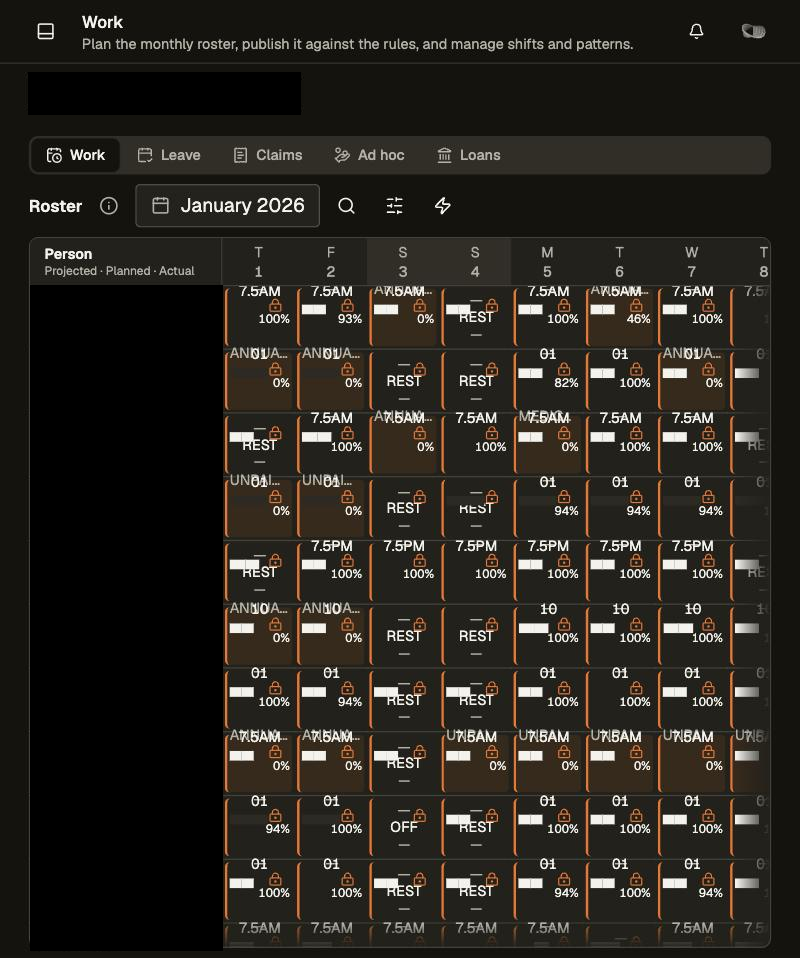
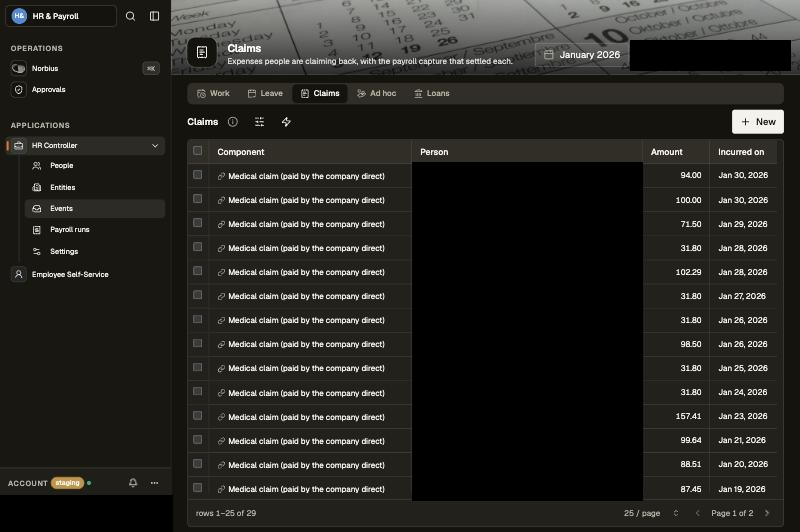
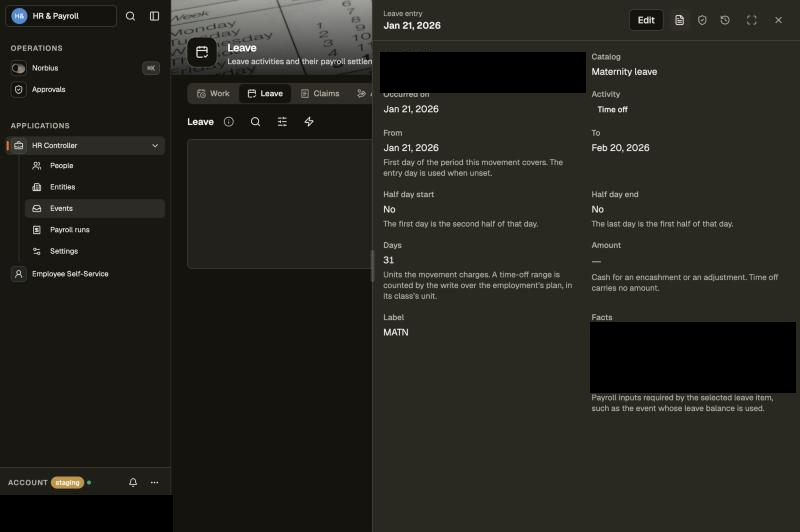
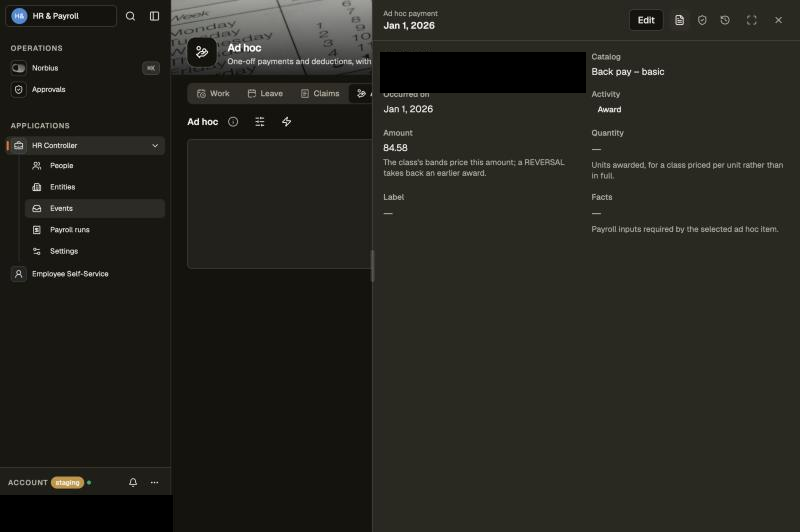
Loan repayment locks and consumed entries, captured on staging:
Compliance audit (2026-10-21)
One researcher per jurisdiction read the official sources on the web and compared them with the in-force seed. Each report in docs/audit lists the sources table (reachability, relevance, overlap), uncovered areas, the findings with citations, and the log of every URL fetched.
| Code | In force | Compliant | Wrong | Missing | Most severe |
|---|---|---|---|---|---|
| SG | version_5 | 41 | 1 | 2 | Carried-forward annual leave not paid on exit (EA s.88A); needs an engine change |
| MY | version_9 | 31 | 0 | 1 | Sabah and Sarawak worksites refused (could be data); substitute holidays only warn |
| PH | version_2 | 23 | 1 | 0 | 2027 additional special non-working days (Proc. 1427: 6 Feb, 27 Mar, 2 Nov, 24 Dec) wrongly left out |
| ID | version_4 | 44 | 0 | 3 | 2027 national holidays not seeded (SKB signed 15 Sep 2026) |
| VN | version_4 | 35 | 2 | 4 | Overtime, holiday and night pay priced on base salary only; law includes fixed allowances |
| TW | version_4 | 38 | 2 | 2 | Lineage ends 2026-12-31; §32(4) emergency overtime not doubled; wage-arrears levy rounded per worker |
| CN | version_4 | 34 | 1 | 2 | Shanghai minimum-wage test counts excluded allowances; year-end unused leave not paid at 200% extra |
| JP | version_6 | 22 | 1 | 3 | Customer-harassment duty mandatory since 2026-10-01 but only raised for new entities |
| TH | version_4 | 18 | 2 | 2 | Maternity leave counted in working days, law counts calendar days; no holidays after 2026 |
Resolution (2026-10-22). Every finding above was fixed in the seed, each in place (a wrong transcription) or as a new sealed version (a change of law): sources now state the area each covers with no overlap, missing authorities were added, and every source origin answers an automated reader (unreachable sites were replaced by reachable official mirrors, for example lawphil.net for PH). The second pass also fixed PH maternity double pay, the TW NHI §34 bonus base, the VN insurance base, TH child-care leave, CN menstrual leave and the JP year-end double count, and added TW version_5 (2027). Sample entities observe their jurisdiction's gazetted holidays for the years after the bank's own. Each report's Resolution section lists the change per finding.
Known gaps
- Lane. On the pinned Bolt, one workspace automation runs at a time: a Saturday sweep holds behaviours (exit encashment, holds, pins) until it ends (see Statutory research). Bolt now runs four lanes per workspace (one automation's own runs still one at a time); it reaches this template with the next Bolt release.
- Research outcome. A lineage that runs out of tool time reads as "no change", and a final turn over a large snapshot can exceed the 20 s model wall (CN in the 2026-10-22 run).
- TW §34 bonus premium is netted per run, not per month.
- SG part-time hourly encashment and leave qualifying service, and the CN per-employee year-end payout skip, need engine support.
- Anonymising a former employee blanks the profile but keeps contract-term facts (now holding dependants, spouse status and similar inputs).
- Data still missing from the sample entities is listed per employee in the HR data request
(
docspackage sent to the HR lead).
Seed
- base —
seed/jurisdiction/<CODE>/version_*/: nine sealed jurisdiction lineages with their catalogues and rule sets;seed/overtime_policies.tsadds each version's overtime rule. - sample (private) —
seed/seed.tsreads the seed bank treenorbital_hrwithbolt build --bank=<checkout>: entities, people, contracts, rosters and their records. A roster day's overtime and incentive derive from its clock past the planned shift, so the bank's typed hours are dropped on the way in.
Payroll hotline
Employees ask about their own payslips on WhatsApp, one number per legal entity. The source role is
src/agent/envoy/+payroll_hotline.envoy.ts; its whole authority is the payroll_hotline policy.
- An administrator adds and pairs a WhatsApp instance in Settings, Integrations.
- On the entity's General tab, HR picks that number as the payroll hotline (
entity.hotline), saves, and selects Answer payroll questions on this number. - An administrator records each employee's WhatsApp number on their account (Settings, People); an employment profile
links to the account through
user_id.
A DM holds payroll_hotline alone, even for an administrator: it reads only the sender's own payslips of the entity
written to (salary_from, salary_to, status, currency, gross, total_deductions, net, paid_at) and writes
nothing. Leave, claims and corrections go to self-service or HR. A number on no account gets one fixed notice; group
messages are ignored. envoys.receive allows 10 messages a minute per sender and 300 a minute across every hotline.
Checks
pnpm install
pnpm check      # bolt check
pnpm test       # bolt build --bank=$SEED_BANK (default ../../seed_bank), bolt test, then test:node
pnpm test:node  # vitest.node.config.ts: the node-side suites in tests/
pnpm lint       # prettier --check .